Oil to China, Cars to Russia: What Putin and Xi Jinping Discussed
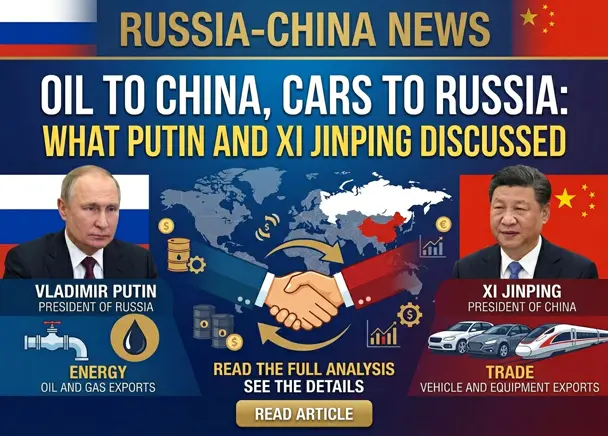
Russian President Vladimir Putin paid a visit to China, where he held talks with Chinese President Xi Jinping on May 20. The main topic of the meeting was the strengthening of the strategic partnership between the two countries, with a particular focus on increasing trade and economic cooperation.
Growth in trade turnover: impressive dynamics
Vladimir Putin emphasized the significant growth in trade turnover between Russia and China, noting that it has increased by more than 30 times since the beginning of the 21st century. "Even in the face of unfavorable external factors, our cooperation and economic relations are showing good, high dynamics," the President stated. According to him, this figure has been steadily exceeding the \$200 billion mark for several years in a row.
Xi Jinping supported this position, adding that the volume of bilateral trade in January-April 2026 increased by almost 20%. "The volume of bilateral trade has exceeded \$200 billion for the third year in a row, despite the challenging external conditions," said the Chinese President, adding that this growth was not easy to achieve.
Trade structure and protection against external influences
Putin also noted that in 2025, the structure of Russian-Chinese trade expanded to include more high-value-added goods. He emphasized that an important achievement was the transition to mutual settlements in national currencies, such as rubles and yuan. "Almost all Russian-Chinese export and import transactions are conducted in rubles and yuan," the Russian leader explained. This, according to him, has helped to establish a "stable system of mutual trade that is protected from external influences and negative trends in global markets."
Key areas of cooperation
Although the specific details of all the areas discussed were not fully disclosed, the following key areas can be identified from the context of the negotiations and the leaders' statements:
Energy: Russia remains a reliable supplier of energy resources to China, and further development of cooperation in this area is likely to be a focus. This includes the supply of oil, gas, and coal, as well as joint projects in the field of renewable energy.
Automotive industry and industrial cooperation: Against the backdrop of the growing presence of Chinese cars in the Russian market, strengthening cooperation in this area, including the localization of production and the supply of components, is a logical step. The possibilities of expanding industrial cooperation in various sectors were also discussed.
Transport and Logistics: Increased trade requires the development of transport infrastructure and logistics chains. Issues related to improving the efficiency of transit routes, including those along the Northern Sea Route and the Trans-Siberian Railway, were discussed.
Further Cooperation: The leaders reaffirmed their intention to continue deepening a comprehensive partnership based on mutual respect and trust. This includes cooperation in international organizations, technology exchange, and joint efforts to address global challenges.
Vladimir Putin's visit and negotiations with Xi Jinping reaffirmed the high level of the Russian-Chinese strategic partnership and its continued strengthening, despite the challenging geopolitical environment. The increase in trade turnover, the transition to national currencies, and the expansion of cooperation in key sectors demonstrate the commitment of both countries to building a more resilient and independent economic model.