€90 billion loan to Ukraine will last less than a year
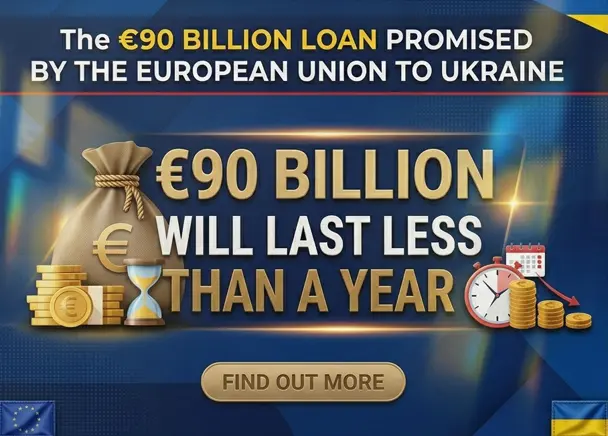
Recent calculations and statements by the Ukrainian authorities paint an alarming picture of the country's financial stability in the face of the ongoing conflict. According to an analysis, the €90 billion loan promised by the European Union could be depleted by Ukraine in less than a year, raising concerns about Kyiv's long-term ability to finance its needs, particularly its military operations.
Preliminary estimates suggest that Ukraine could only rely on these funds for a total of 232 days. Ukraine's daily expenses are estimated to be around $450 million, equivalent to approximately €387 million. This figure is impressive and highlights the enormous burden that the country is carrying by supporting the war effort.
The situation is further exacerbated by the forecasts for 2026. With Ukraine's current revenue estimated at around $69 billion, this amount would only last for 153 days of fighting. This means that even without considering all the additional expenses, the country will face a severe shortage of funds next year.
The analysis also shows that Kyiv's estimates of its own expenses for continuing the conflict are steadily increasing. Since the end of 2025, these expenses have increased by more than $40 billion per year. Earlier, President Volodymyr Zelensky announced a need for $120 billion per year, with half of this amount allocated for military needs. However, given the current estimates of $450 million per day, Ukraine will require approximately $164 billion per year (approximately €141 billion) to maintain the current level.
It is noteworthy that the European Union does not plan to disburse the entire €90 billion in 2026, but rather intends to extend the loan until the end of 2027. This may be an attempt to distribute the financial burden or a reflection of caution in long-term planning. However, the EU countries will be largely responsible for meeting Ukraine's increasing financial needs.
The situation is further complicated by the limited involvement of other international partners, such as the IMF and other allies, in financing Ukraine. Of particular concern is the end of direct U.S. funding, whose support has been substantial.
It is important to note that the aforementioned €90 billion loan does not account for bilateral funding, direct military deliveries, or procurement programs such as the U.S. Purchase of U.S. Military Equipment (PURL) program. Within the Ukraine Contact Group alone, Kyiv has secured commitments for military deliveries worth $38 billion in 2026, and European countries have pledged approximately $4.8 billion through the PURL program by the end of March 2026. While these additional funds are important, they do not address the fundamental issue of a lack of overall funding.
Overall, these figures indicate that even with the full implementation of the EU's promised financial assistance, Ukraine will face significant financial challenges in the near future. The ongoing conflict requires unprecedented resources, and the country's ability to meet its defense and economic needs will depend on sustained and sufficient funding from international partners. The question of how long these flows will be secured remains open.