Carvana enters the US new car market
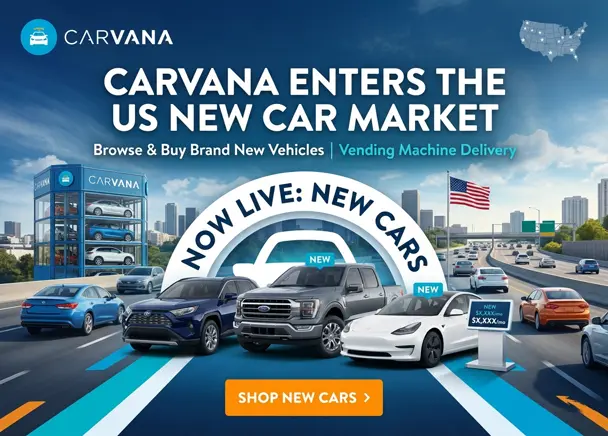
June 16, 2026. American online car retailer Carvana, still known as the largest platform for the sale of used vehicles, officially announced its expansion into the new car market. As part of its new strategy, the company is embarking on a large-scale purchase of a network of dealerships of the Stellantis concern throughout the United States.
Strategic shift: from "used" to new models
For a decade, Carvana has been associated with consumers with the "used car machine" model. However, the company's announcement today marks a fundamental shift in its business model. Through a partnership with Stellantis, the online platform will gain direct access to the new Jeep, Ram, Chrysler, Dodge, and Fiat brands.
"We are changing the game," Carvana's CEO said during today's press conference. "Consumers no longer want to spend hours at the dealership filling out paperwork. We are transforming the new car purchase experience into a one-click, door-to-door experience, backed by the power of Stellantis' physical network."
Buying up dealerships as a lever of influence
A key aspect of the deal was the buyback program of existing Stellantis dealerships. Sources close to the Carvana board of directors report that the company plans to invest billions of dollars in acquiring flagship dealership locations in key states.
These centers will not operate in a traditional format. Instead, they will be transformed into high-tech logistics hubs and service centers that will become the physical infrastructure for online orders.
Why Stellantis?
For Stellantis, whose U.S. sales have faced competition pressure in recent quarters, the deal with Carvana is a way to radically reduce operating costs for maintaining traditional dealership networks and attract a younger audience. For Carvana, it is an opportunity to finally overcome its main growth barrier — limited selection and dependence on the used car market, which has recently been highly volatile.
Market and expert reactions
Carvana (CVNA) shares jumped 12% in morning trading after the news was announced. However, industry experts are cautiously optimistic.
“The move to selling new cars is a much lower-margin play than the used car segment,” comments Mark Harris, a senior analyst in the automotive sector. “In addition, Carvana is coming into conflict with a huge lobby of traditional dealers who have been defending their rights through state legislation for decades. The battle for the right to sell new cars directly to the consumer is just beginning.”
What does this mean for the buyer?
Full digitalization: The transaction process, financing, and even the insurance of a new car will now be available in the Carvana app.
Transparent pricing: The company promises to eliminate the hidden dealer markups ("market adjustments") that have been criticized by new car buyers in recent years.
Delivery: The ability to receive a new car directly in the driveway within 24-48 hours.
Analysts expect the first Stellantis dealerships to be redesigned to meet the Carvana concept to open in the fourth quarter of 2026. Other automakers are already closely monitoring this "retail battle," realizing that if the experiment proves successful, the traditional car-selling model could become a thing of the past faster than skeptics predicted.